Ecommerce OMS vs Marketplace Tools: Key Differences (2026)
Table of Contents

Share On


Ecommerce OMS vs Marketplace Tools: Key Differences
Selling on one marketplace is operationally simple compared with selling across many. The moment a business adds its own webstore, a second marketplace, regional fulfillment partners, or multiple warehouse locations, order management gets harder very quickly.
That is why the conversation around ecommerce OMS vs marketplace tools matters more in 2026 than it did a few years ago. What worked when your team was managing one sales channel manually may now be creating delays, inventory mismatches, fulfillment exceptions, and unnecessary operational overhead.
Marketplace native tools are useful. They help sellers receive orders, update statuses, and manage basic workflows inside a specific platform. But they are built around the needs of that marketplace, not around the needs of your wider business.
An ecommerce order management system is different. It is designed to centralize orders, inventory, routing logic, and fulfillment workflows across channels. That difference becomes critical when growth creates complexity.
This guide breaks down the real differences between marketplace tools and OMS platforms, when each option makes sense, and how to decide which model fits your business.
Why this comparison matters now
Many ecommerce teams do not choose between an OMS and marketplace native tools at the beginning. They start with the native tools because that is the fastest way to get selling.
That approach works for a while.
Problems usually appear later, when the business starts asking for more than one platform can comfortably support. Common triggers include:
- Expanding into multiple marketplaces
- Running a D2C site alongside marketplace sales
- Managing inventory across more than one warehouse
- Trying to reduce split shipments or delayed fulfillment
- Needing more control over order routing
- Wanting better reporting across channels
- Growing a larger operations team that needs one shared source of truth
At that point, the question is no longer whether marketplace tools are useful. The real question is whether they are enough.
What marketplace native tools actually do
Marketplace native tools are the built-in order and seller management capabilities provided by a marketplace platform. They usually cover the basics needed to operate within that ecosystem.
Typical functions include:
- Viewing marketplace orders
- Updating order or shipment status
- Managing returns or cancellations within that platform
- Printing labels in supported workflows
- Accessing basic sales and order reports
- Handling platform-specific inventory settings
For a seller operating mainly inside one marketplace, these tools can be practical and cost-effective.
Where marketplace tools work well
Marketplace native tools are often sufficient when the business is still in a relatively simple operating model.
They tend to work best when:
- You sell on a single channel
- Your catalog is limited
- Your team manages low to moderate order volume
- Fulfillment logic is straightforward
- Inventory updates do not need to be coordinated across many systems
- Reporting does not need to unify data from multiple sources
For an early-stage seller, this setup can be perfectly reasonable. There is no need to introduce more software than the business truly needs.
Where they start to break down
The limitation is not that marketplace tools are poor products. The limitation is that they are narrow by design.
A marketplace tool is built to help you operate inside one marketplace environment. It is not built to orchestrate the full order lifecycle across multiple channels, systems, warehouses, and service providers.
That creates problems such as:
- Orders managed in separate dashboards
- Inventory updates that are not synchronized in real time
- Manual work to coordinate stock across channels
- Inconsistent fulfillment decisions
- Higher risk of overselling or stockouts
- Limited automation across the end-to-end workflow
- Reporting that stays fragmented by platform
As complexity rises, operations teams often respond by adding more manual checks, more spreadsheets, and more people. That may keep things moving temporarily, but it rarely scales well.
What an ecommerce order management system does differently
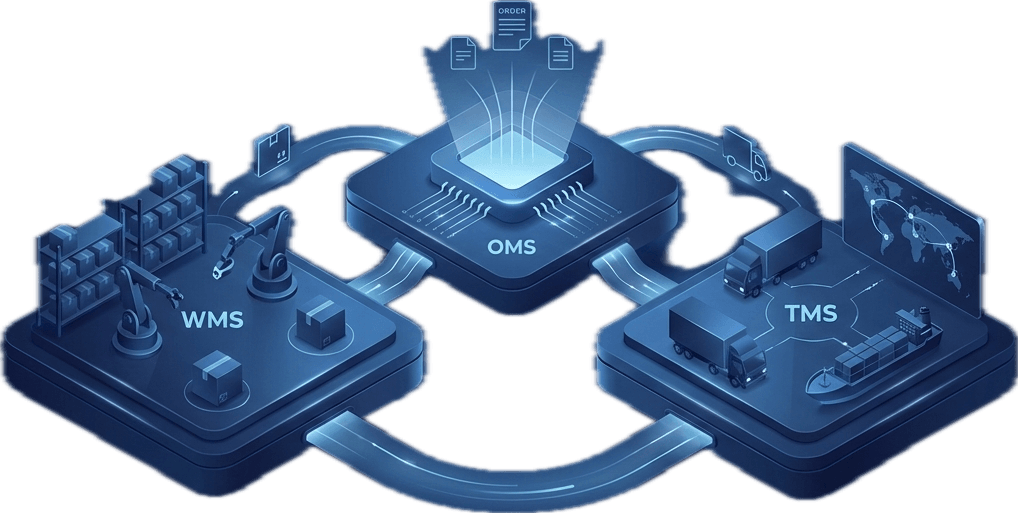
An ecommerce order management system sits above the channel level. Instead of managing one marketplace in isolation, it manages orders and fulfillment logic across the business.
This is the most important distinction in the OMS vs marketplace comparison.
An OMS does not replace every marketplace function. It gives the business a centralized operational layer where orders, inventory signals, fulfillment rules, and exceptions can be managed more consistently.
Centralized order visibility
A strong OMS brings orders from multiple channels into one environment. That gives operations, customer service, and leadership teams a clearer view of what is happening across the business.
Instead of checking separate systems, teams can work from a shared operational picture.
This supports:
- Faster issue resolution
- Better order tracking
- Clearer exception handling
- Easier workload management
- Stronger team alignment between ecommerce, operations, and support
Order routing and fulfillment automation
One of the biggest functional advantages of an OMS is order routing automation.
Rather than sending every order through a fixed manual path, an OMS can apply rules based on business priorities such as:
- Inventory availability
- Warehouse proximity
- Delivery promise windows
- Shipping cost
- Capacity constraints
- Marketplace or channel-specific service rules
This is where ecommerce fulfillment systems become strategically important. They do not just help process orders. They help process them more intelligently.
Cross-channel inventory coordination
Marketplace tools generally reflect the inventory logic of their own platform. An OMS helps coordinate inventory across all relevant channels and fulfillment nodes.
That matters when you need to:
- Reserve stock accurately
- Reduce overselling
- Prioritize high-value channels
- Route inventory by region
- Use safety stock logic
- Sync inventory changes more consistently across systems
For businesses with increasing SKU count or channel complexity, this is often where the operational ROI becomes most visible.
Ecommerce OMS vs marketplace tools: the core differences
Here is the clearest way to think about ecommerce OMS vs marketplace tools: one is channel-specific, the other is business-wide.
Scope
Marketplace native tools manage operations within a specific platform.
An OMS manages orders and fulfillment across multiple channels, systems, and operational workflows.
If the marketplace tool answers, “What is happening on this platform?” the OMS answers, “What is happening across the business?”
Scalability
Marketplace tools support growth inside a marketplace. An OMS supports growth across channels and operating models.
That distinction matters for brands expanding into:
- Multiple marketplaces
- Owned ecommerce channels
- Regional warehouse networks
- B2B and B2C sales models
- Cross-border operations
- More advanced fulfillment strategies
This is why growing brands often move from platform-native workflows toward centralized order management.
Automation
Marketplace tools usually offer workflow support within that marketplace. OMS platforms support broader automation across order ingestion, allocation, routing, split logic, fulfillment coordination, and exception handling.
The value is not just labor savings. Better automation can also improve:
- SLA consistency
- Order accuracy
- Throughput
- Customer experience
- Team productivity
Inventory visibility
Inventory is one of the biggest operational fault lines in ecommerce.
Marketplace tools can show what is happening on their own platform. But businesses operating across channels need a wider view of available, reserved, in-transit, and channel-committed inventory.
An OMS contributes to multi-channel order management by helping the business make smarter inventory decisions across the full selling environment.
Reporting and decision-making
Leaders do not just need order data. They need operational insight.
Marketplace-native reporting is often useful but limited to a single ecosystem. OMS reporting can help teams understand:
- Order volume by channel
- Fulfillment performance by warehouse
- Exception trends
- Delay patterns
- Allocation quality
- Inventory availability risk
- Cross-channel efficiency
That supports stronger operational planning and better revenue decisions.
Integration flexibility
Marketplace tools are designed around their own platform boundaries.
An OMS is typically more useful when the business needs to connect with:
- Ecommerce platforms
- ERP systems
- WMS platforms
- Shipping and carrier tools
- Customer support systems
- Finance systems
- Returns platforms
- Analytics tools
For brands evaluating long-term infrastructure, this flexibility matters as much as feature depth.
When marketplace native tools are enough
Not every business needs an OMS immediately.
Marketplace native tools can be enough if your business fits most of the following conditions:
- You mainly sell on one marketplace
- Order volume is manageable without advanced routing logic
- Inventory complexity is low
- You are not yet operating across multiple warehouses or fulfillment nodes
- Your team can run workflows effectively inside one platform
- Reporting needs are relatively basic
In that stage, the best decision may be to keep operations lean and avoid adding complexity too early.
A marketplace-native setup is not a bad decision when it matches the business model. The problem starts when businesses keep using it long after the operating reality has changed.
When businesses should move to an OMS
Businesses usually move to an OMS when growth creates coordination problems that channel-level tools can no longer solve well.
Operational signs you have outgrown marketplace tools
Here are some practical signals:
1. Your team manages orders in multiple dashboards
When teams are constantly switching between channels to check status, inventory, and exceptions, productivity drops and errors increase.
2. Inventory sync issues are affecting customer experience
If stock discrepancies are creating cancellations, delays, or poor promise accuracy, your infrastructure is likely too fragmented.
3. Fulfillment decisions are still manual
If people are deciding warehouse allocation or routing order by order, scale will become expensive.
4. Reporting is fragmented
When leadership cannot easily answer simple cross-channel questions, operational visibility is too limited.
5. Growth is increasing team strain faster than revenue efficiency
If order volume growth requires disproportionate growth in manual effort, your current model is not scaling well.
These are strong indicators that OMS for retail brands is no longer a “nice to have.” It is becoming core infrastructure.
A practical decision framework for choosing the right setup
A useful way to evaluate the right setup is to look at the business across four dimensions: channel complexity, fulfillment complexity, operational control, and growth horizon.
Questions to ask before you invest
How many active selling channels do we operate today, and how many are planned?
A single-channel seller has very different needs from a brand running D2C, marketplaces, social commerce, and wholesale together.
How complex is our fulfillment network
One warehouse is simpler than multiple warehouses, dark stores, retail nodes, or regional distribution centers.
How much automation do we need?
If your business benefits from rules-based routing, exception handling, inventory prioritization, or service-level management, an OMS becomes more relevant.
How expensive are current operational inefficiencies
You do not need a spreadsheet full of precise benchmarks to know whether the current setup is causing business drag. Look for patterns such as delayed fulfillment, overselling, manual reconciliation, customer complaints, or decision latency.
Are we choosing for today’s size or next year’s operating model?
This is one of the most important questions. The best system is not always the cheapest current option. It is the one that supports the next phase of growth without forcing a costly process reset later.
Common buyer objections and how to think about them
Even when the case for an OMS is strong, buyers often hesitate for reasonable reasons.
Marketplace tools are free or already included
That is true in many cases. But included tools are not automatically lower-cost in practice. The real cost includes manual work, error handling, operational friction, and growth limitations.
A lower software cost can still produce a higher operating cost.
“An OMS sounds complex to implement”
Implementation complexity is a valid concern. The right question is not whether an OMS requires effort. It is whether the effort leads to meaningful time-to-value.
For many businesses, the answer depends on integration readiness, internal process maturity, and whether the OMS aligns with the actual operating model.
“We are not big enough yet”
Sometimes that is true. Sometimes it is a delay rooted in underestimating current complexity. A better test is not company size alone. It is whether the business already faces cross-channel coordination problems that are slowing execution.
“Can’t we just connect more apps around our marketplace tools?”
In some cases, yes. But app stacks can become fragile when they are compensating for missing operational architecture. More point solutions do not always create more control.
At a certain point, businesses need orchestration, not just more connectors.
Final takeaway: choose for the business you are building next
The debate around ecommerce OMS vs marketplace tools is not about which option is universally better. It is about which option fits your operational reality.
Marketplace native tools are useful for focused, early-stage, or low-complexity selling models. They help businesses get started quickly and operate effectively within a specific channel.
But as channel count, fulfillment complexity, and operational expectations grow, those tools often stop being enough. That is where an ecommerce order management system becomes valuable. It gives the business centralized control, better automation, stronger inventory coordination, and a more scalable foundation for growth.
If your business is still managing complexity through separate dashboards, manual routing decisions, and patchwork reporting, it may be time to move from channel-specific tooling to centralized order management.
The best decision is not the one that solves the smallest problem today. It is the one that supports better execution, clearer visibility, and healthier growth over time.
For teams evaluating the next step in ecommerce OMS vs marketplace tools, the most useful starting point is simple: map your current order flow, identify where manual work or visibility gaps are slowing the business, and assess whether your existing tools are helping you scale or merely helping you cope.
FAQs
What is the difference between an OMS and marketplace tools?
An OMS centralizes order management across multiple channels, warehouses, and fulfillment workflows. Marketplace tools mainly help manage orders within one specific marketplace platform.
When should businesses use an ecommerce OMS instead of marketplace tools?
Businesses should consider an ecommerce OMS when they sell across multiple channels, need better automation, want centralized inventory visibility, or are struggling with manual fulfillment coordination.
Are marketplace native tools enough for growing ecommerce brands?
They can be enough in the early stages, especially for single-channel operations. But they often become limiting as brands expand across channels and need more scalable operational control.
How does an OMS improve ecommerce operations?
An OMS improves operations by supporting order routing automation, centralized order visibility, better inventory coordination, and more consistent fulfillment execution across channels.
Is an OMS only for large enterprises?
No. An OMS is useful whenever operational complexity justifies it. Mid-sized and growing ecommerce brands often adopt OMS platforms before they become large enterprises because coordination issues appear earlier than many teams expect.
What is the best solution for ecommerce order management?
The best solution depends on channel count, fulfillment complexity, growth plans, and operational needs. Marketplace tools may be enough for simple setups, while an OMS is usually the better fit for multi-channel businesses that need scale and control.
Share On