WMS vs OMS vs TMS: The Honest Breakdown Every Operations Leader Needs in 2026
Table of Contents

Share On


WMS vs OMS vs TMS: The Honest Breakdown Every Operations Leader Needs in 2026
Most supply chain software decisions start with the wrong question. Operations leaders ask "which WMS should I buy?" when the question they actually need to answer is "how do my warehouse, order, and transportation systems need to work together — and do I have a platform that lets them?"
The difference between those two questions costs real money. Businesses that buy a WMS, bolt on an OMS from a different vendor, and stitch in a TMS as an afterthought spend months and hundreds of thousands of dollars managing integrations that should have been native. When those integrations fail — and they eventually do, usually during peak season — the operational fallout is immediate: orders split incorrectly, inventory counts diverge, and delivery windows get missed.
This guide cuts through the confusion. It explains what a WMS, OMS, and TMS each actually do, where they interact, what breaks when they're disconnected, and how to decide what your specific operation needs. If you're evaluating supply chain software in 2026, this is the framing you need before you look at a single vendor demo.
What Is a WMS — and What Does It Actually Manage?
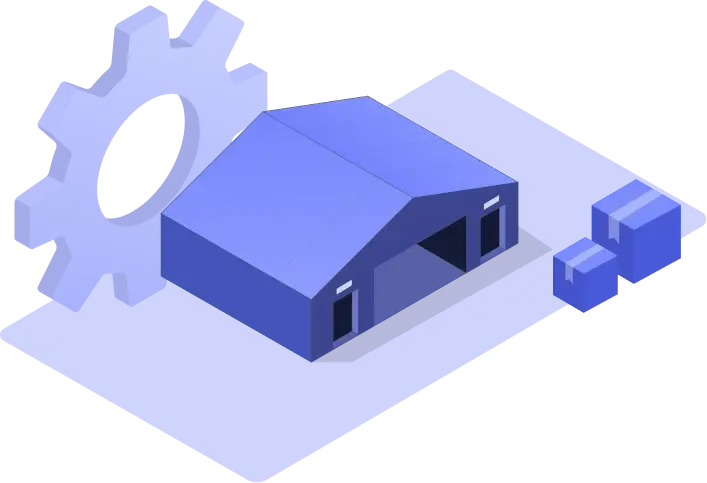
A Warehouse Management System (WMS) controls what happens inside your four walls. That means it governs every movement of inventory from the moment goods arrive at the receiving dock to the moment a packed order leaves on a carrier.
In practical terms, a WMS handles:
- Receiving and putaway — verifying incoming stock against purchase orders, assigning storage locations, and directing workers or automation to put items in the right place
- Inventory tracking — maintaining a real-time record of where each SKU is located, how many units are available, reserved, or on hold
- Picking, packing, and shipping execution — generating pick lists, routing pickers through the warehouse efficiently, validating items at pack stations, and generating shipping labels
- Labor management — tracking worker productivity, managing task assignments, and identifying throughput bottlenecks
- Returns processing — managing inbound returned goods, assessing condition, and restocking or disposing of items appropriately
What a WMS does not do: it doesn't know where an order came from, what channel the customer used, what the delivery promise was, or how the shipment will route to the customer. It operates on execution signals it receives — from an OMS or ERP — and executes them accurately. That boundary is important.
For ecommerce brands, 3PLs, and omnichannel retailers managing meaningful volume, a purpose-built WMS is non-negotiable. Generic ERP warehouse modules can't handle pick path optimization, multi-zone picking, or real-time labor management at any serious throughput level.
What Is an OMS — and Where Does It Start and Stop?
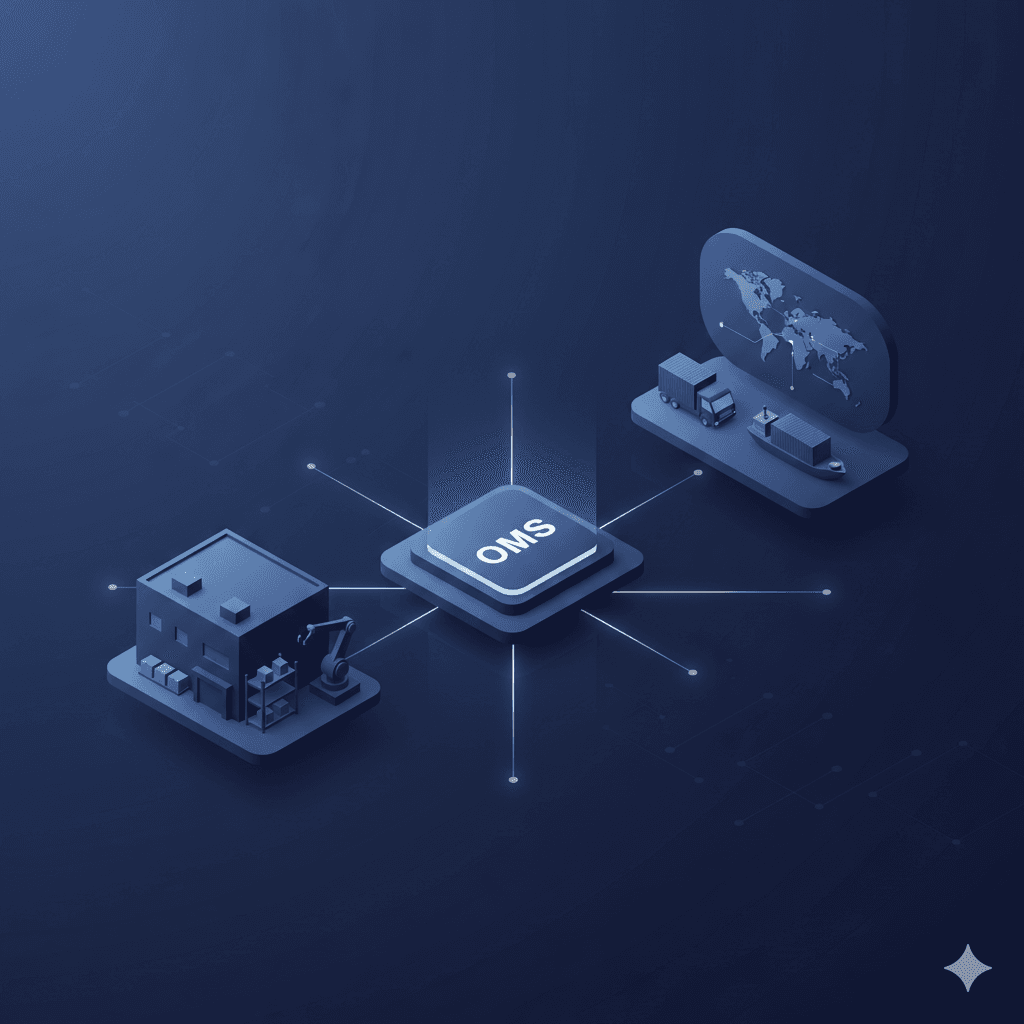
An Order Management System is the commercial brain of your fulfillment operation. It sits upstream of the warehouse and downstream of your sales channels, acting as the orchestration layer that decides what to do with an order once it's placed.
An OMS manages:
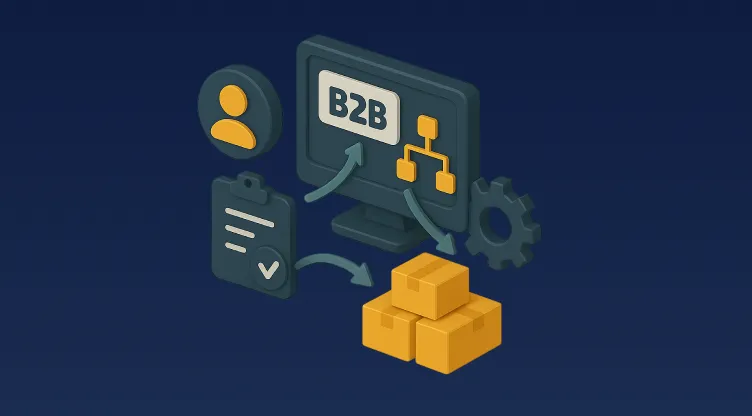
- Order ingestion — pulling orders from every sales channel (ecommerce store, marketplace, B2B portal, POS system) into a single, unified queue
- Inventory availability logic — determining what's actually available to promise across all locations, accounting for reservations and in-transit stock
- Order routing — deciding which fulfillment node (warehouse, store, 3PL, dark store) should fulfill each order based on rules you define: proximity to customer, stock availability, shipping cost, SLA
- Order splitting and consolidation — managing cases where a single order needs to be fulfilled from multiple locations or batched for efficiency
- Customer-facing order status — feeding tracking and status updates back to the channel so customers know where their order is
- Returns orchestration — determining where a return should go and what to do with it operationally
Where an OMS stops: once it sends a fulfillment directive to a warehouse or 3PL, execution is the WMS's responsibility. The OMS shouldn't care whether your warehouse runs single-zone picking or zone-batch picking — that's internal warehouse logic. The OMS cares that the order gets out the door correctly and on time.
An OMS is particularly valuable the moment you start operating more than one sales channel or more than one fulfillment location. A brand selling only on their own Shopify store from a single warehouse can often survive without a dedicated OMS. A brand selling on Shopify, Amazon, and a wholesale portal while fulfilling from two warehouses and a 3PL cannot — not without one.
What Is a TMS — and Why Do Ecommerce Teams Keep Underestimating It?
A Transportation Management System handles what happens after your orders leave the warehouse. It manages carrier selection, shipment routing, freight cost optimization, and delivery tracking.
Core TMS capabilities include:
- Carrier management and rate shopping — connecting to multiple carriers and selecting the best rate and service level for each shipment automatically
- Shipment planning and tendering — organizing outbound shipments, building loads, and tendering freight to carriers
- Route optimization — for last-mile or own-fleet operations, optimizing delivery routes to reduce cost and improve delivery windows
- Freight audit and pay — validating carrier invoices against agreed rates and flagging discrepancies
- Delivery tracking and visibility — aggregating carrier tracking data to give a single view of shipment status across the network
The TMS sits at the final stage of the fulfillment stack and directly determines the customer experience. Delivery speed, cost, and reliability are TMS-adjacent problems. Yet many ecommerce brands treat TMS functionality as an afterthought — often relying on the shipping functionality baked into their WMS or ecommerce platform, which rarely goes deep enough.
The TMS gap is increasingly dangerous in 2026. Consumer expectations for same-day or next-day delivery, combined with rising carrier costs and increasingly complex multi-carrier networks, mean that carrier selection and delivery routing are now competitive differentiators. Brands managing high shipment volume without a proper TMS layer are leaving cost savings on the table and creating delivery inconsistency that shows up in reviews and return rates.
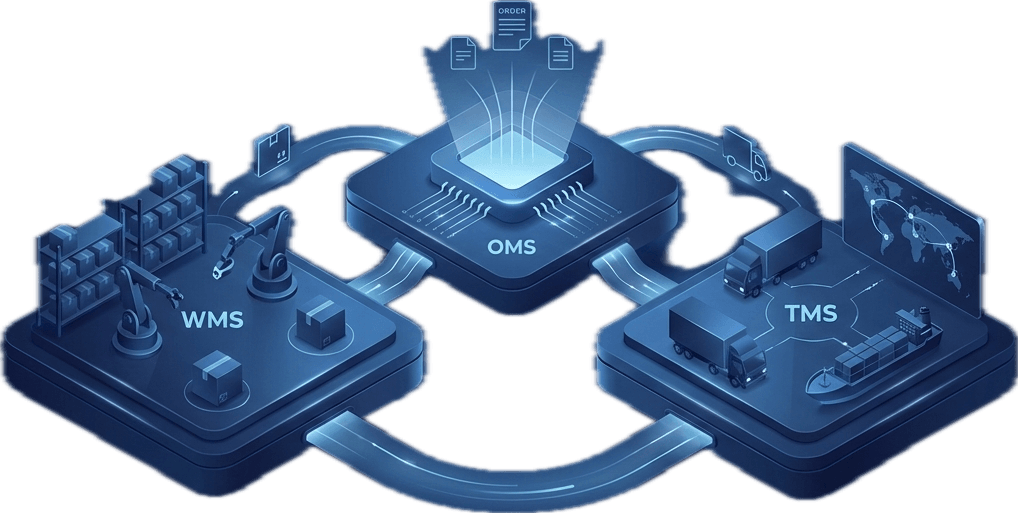
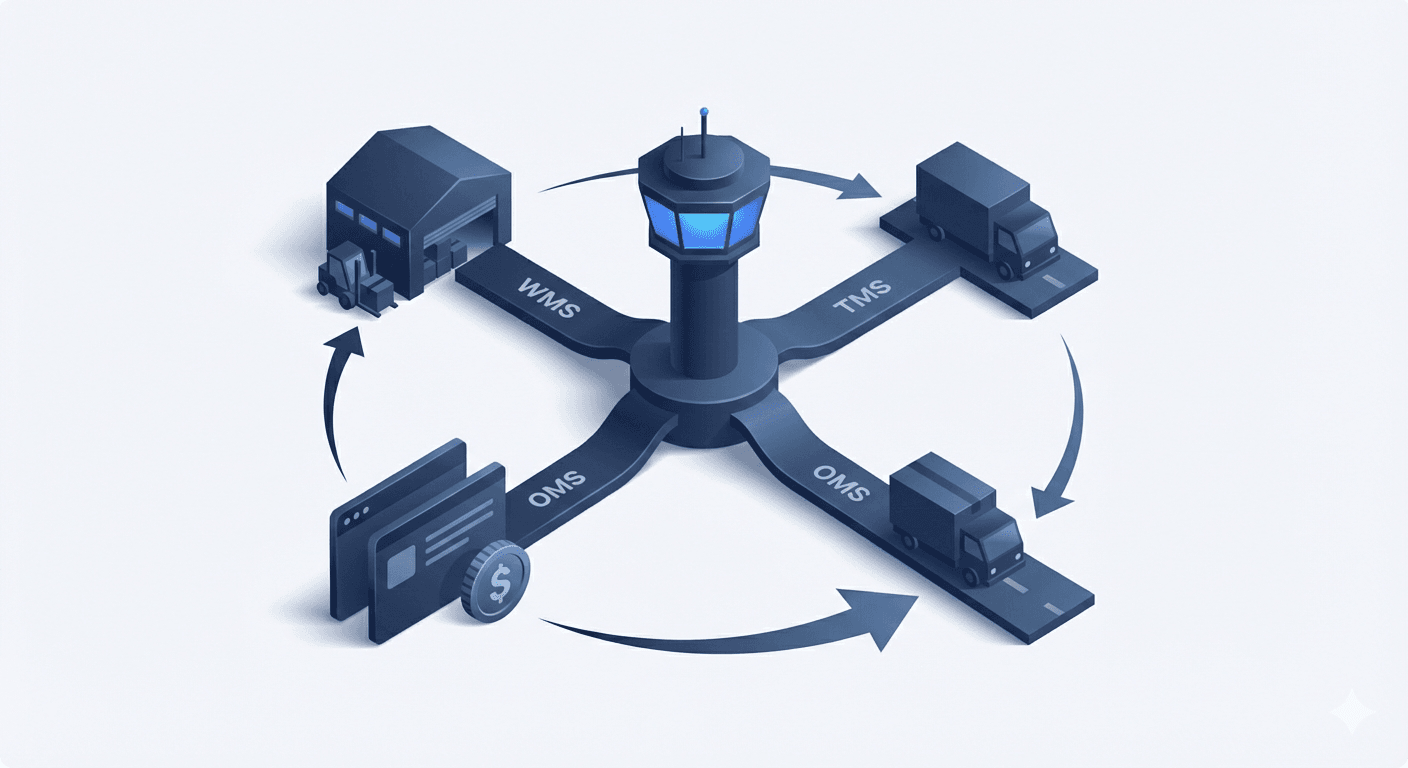
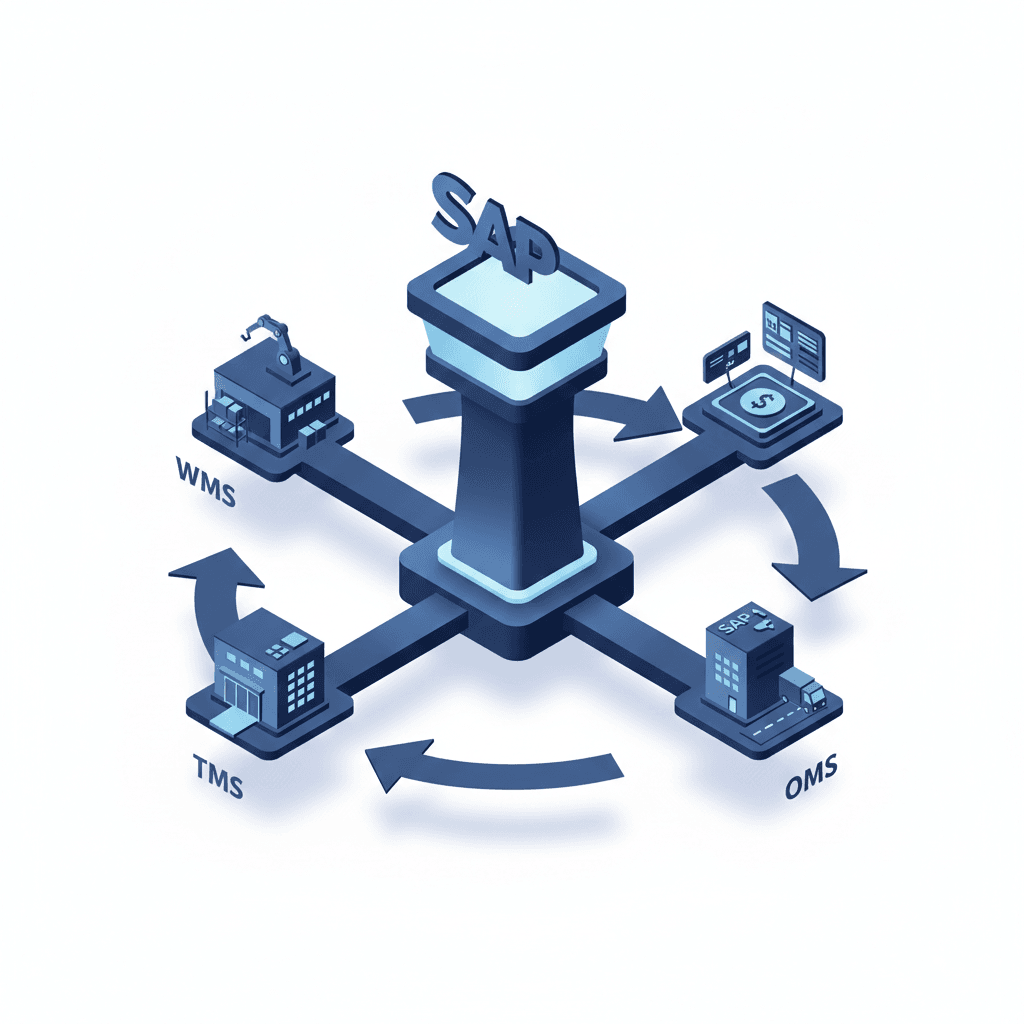
How WMS, OMS, and TMS Interact Operationally
Understanding each system in isolation is necessary but not sufficient. The real challenge — and the real opportunity — is understanding how they interact.
Here's the operational flow in a well-integrated supply chain:
- Customer places an order → the OMS receives it, checks available-to-promise inventory across all locations, applies routing rules, and decides which fulfillment node should handle it.
- OMS sends a fulfillment directive → the WMS at the assigned location receives the pick instruction, locates the items, routes the pick task to a worker or robot, and executes pick-pack-ship.
- WMS triggers shipment creation → the TMS receives shipment details, selects the optimal carrier and service based on delivery promise, cost, and carrier performance data, and generates the shipping label.
- Carrier picks up the shipment → the TMS tracks it in real time and feeds status updates back to the OMS, which surfaces them to the customer.
- Delivery completed (or return initiated) → the OMS orchestrates the return routing, the WMS handles physical receipt and restocking, and inventory is updated across all systems.
In a well-connected system, this loop runs without manual intervention and closes in real time. When any link in the chain is broken — because systems can't communicate, data is stale, or routing logic isn't shared — the entire loop degrades.
What Breaks When These Systems Are Disconnected
This is where most operations leaders learn the cost of fragmented stacks. The failure modes are predictable, but they're often invisible until they compound.
Inventory divergence: When the WMS and OMS don't share real-time inventory data, the OMS may promise inventory that the warehouse has already picked for another order, or that's been held as safety stock, or that's physically damaged but not yet flagged. Overselling and stockouts follow.
Routing errors: If the OMS makes fulfillment decisions without accurate warehouse capacity data (queue depth, labor availability, pick backlogs), it can route orders to a node that's operationally overwhelmed. The result is SLA breaches that the OMS has no visibility into until it's too late.
Carrier cost bloat: Without a TMS layer that connects to real-time carrier rates and delivery promises, shipment decisions are often made by default (cheapest carrier, always) rather than by optimization (best rate for the required service level, given current carrier performance). The hidden cost of this at scale is substantial.
Returns chaos: Returns require all three systems to communicate simultaneously — the OMS to authorize the return and decide where it goes, the WMS to receive and process it, and the TMS to handle the return shipment. Disconnected systems mean returns are handled manually, slowly, and inconsistently.
Peak season amplification: Every integration failure mode described above is manageable at low volume. At peak volume — Black Friday, seasonal campaigns, promotional spikes — each of these failure modes amplifies by the same factor as order volume. Brands that run disconnected stacks at peak often end the season with damaged customer relationships and inflated operational costs they're still unraveling six months later.
When You Need One System, Two, or All Three
The right answer depends on your operational profile. Here is a practical decision framework:
You need a WMS if:
- You operate a warehouse with more than a few thousand SKUs and meaningful daily shipment volume
- You're running pick errors that are driving customer complaints or returns
- You have multiple warehouse zones, putaway rules, or fulfillment workflows that a spreadsheet or ERP module can't manage
- You're working with a 3PL that offers WMS access — or you're the 3PL
You need an OMS if:
- You sell on more than one channel (ecommerce + marketplace + wholesale + retail)
- You fulfill from more than one location
- You're struggling with inventory availability promises that don't match what the warehouse actually has
- Your order routing is manual or rule-based in a spreadsheet
- You're doing any volume of B2B or wholesale orders alongside B2C
You need a TMS if:
- You ship more than a few hundred parcels per day and aren't systematically rate shopping
- You operate or manage a delivery fleet for last-mile operations
- You're spending meaningfully on freight and have no way to audit carrier invoices
- You're building out a multi-carrier strategy
- You run dark store or hyperlocal fulfillment operations where route optimization matters
You likely need all three if:
- You operate multiple fulfillment nodes (warehouses, stores, 3PLs, dark stores)
- You sell across multiple channels
- You're managing meaningful shipment volume with multiple carriers
- You're in ecommerce, omnichannel retail, or 3PL operations at any real scale
The honest answer for most mid-market and scaling ecommerce brands is: you need all three. The question is not whether to have WMS + OMS + TMS capability — it's whether you want to buy and integrate three separate systems or operate a platform where those capabilities are already connected.
Should You Integrate Three Systems or Run a Unified Platform?
This is the make-or-buy decision most supply chain software evaluations eventually reach.
The integration path means buying a best-of-breed WMS, OMS, and TMS from different vendors and connecting them via APIs or middleware. The theoretical upside is that you can choose the strongest solution in each category. The practical reality involves significant integration cost and maintenance burden. Every vendor upgrade can break an integration. Every data model change requires reconciliation. Every peak season tests integrations that were built for average volume. The total cost of ownership is often significantly higher than the sticker price of the software.
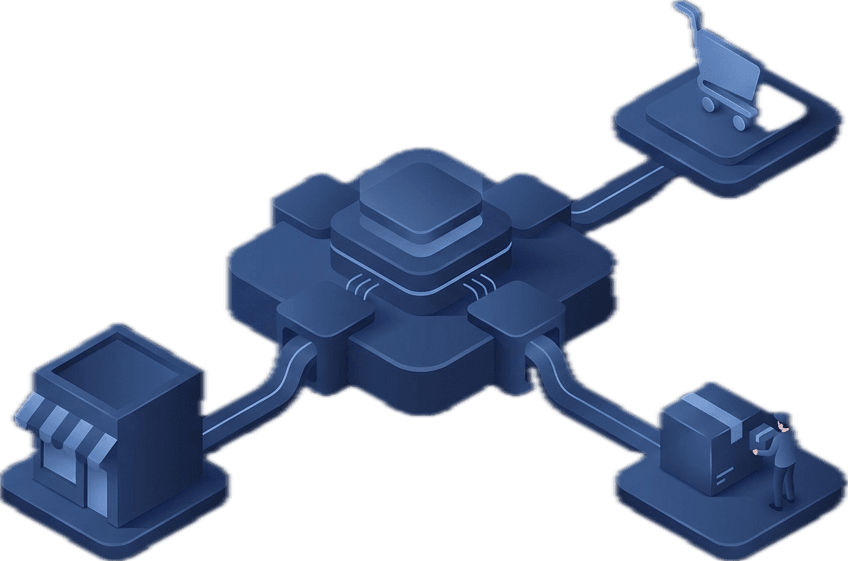
The unified platform path means buying a platform that operates WMS, OMS, and TMS capabilities from a shared data model. Inventory is the same object across all layers. Order status is visible from warehouse to doorstep. Routing decisions have access to real-time warehouse capacity and carrier performance simultaneously. The tradeoff is that you're betting on one vendor's depth across all three functional areas — which means you need to evaluate carefully.
The unified path wins when:
- Speed of deployment matters (integrations can take 6–18 months; unified platforms are faster)
- Operational agility matters (changing routing rules or carrier logic should take hours, not weeks)
- Real-time data across the stack is mission-critical (it is, for omnichannel and high-velocity fulfillment)
- Total cost of ownership is a serious input to the decision
Decision Matrix by Business Type
| Business Type | WMS Needed | OMS Needed | TMS Needed | Platform Recommendation |
|---|---|---|---|---|
| Single-channel DTC brand, single warehouse | Yes (if volume > 500/day) | Optional | Optional | WMS with basic shipping integration |
| Omnichannel brand (ecom + retail + wholesale) | Yes | Yes | Yes | Unified WMS + OMS + TMS |
| 3PL managing multiple clients | Yes | Yes (for client order management) | Yes | Unified platform with multi-client support |
| B2B distributor | Yes | Yes (for complex order rules) | Yes | Unified platform with B2B OMS capabilities |
| Dark store / q-commerce operator | Yes | Yes | Yes (last-mile focus) | Unified platform with delivery orchestration |
| Mid-market retailer with 3+ fulfillment nodes | Yes | Yes | Yes | Unified platform |
| Enterprise retailer (complex, high-volume) | Yes | Yes | Yes | Unified or best-of-breed with heavy integration investment |
Frequently Asked Questions
Q: Can an ERP replace a WMS, OMS, and TMS? ERP systems often include modules for all three, but they rarely go deep enough for operations at meaningful scale. ERP warehouse modules lack the pick path optimization, real-time labor management, and throughput capacity of a purpose-built WMS. ERP order management doesn't typically handle real-time available-to-promise across distributed inventory or omnichannel routing complexity. ERP transportation modules are usually limited to freight management, not ecommerce-grade carrier orchestration. Most mid-market and scaling businesses eventually need purpose-built or unified alternatives.
Q: How long does it take to integrate WMS, OMS, and TMS from separate vendors? A realistic estimate for integrating three separate best-of-breed platforms is 6–18 months, depending on the complexity of your data model and the maturity of each vendor's API. Unified platforms typically deploy in 3–6 months because the integration work is pre-built.
Q: What's the biggest mistake companies make when evaluating WMS, OMS, or TMS software? Evaluating each system in isolation without defining the data flows and decision logic that need to cross system boundaries. If you don't know how available-to-promise inventory should flow from WMS to OMS, or how fulfillment confirmation should flow from WMS to TMS, you won't catch integration gaps until they cause operational failures.
Q: Is a unified WMS + OMS + TMS platform right for smaller operations? If you're operating fewer than 200–300 orders per day from a single location with a single sales channel, you may not need full unified capability yet. But if you're planning to scale, it's worth understanding the platform's growth path early. Switching platforms mid-scale is significantly more expensive than starting with the right foundation.
Q: What's the difference between a TMS and a shipping platform like ShipStation? Shipping platforms handle label generation, rate shopping, and carrier connectivity — essentially the execution layer for individual parcels. A TMS goes deeper: it handles load planning, freight auditing, route optimization for multi-stop delivery, carrier performance management, and strategic transportation network decisions. For high-volume ecommerce or last-mile operations, a TMS is meaningfully more capable.
The Bottom Line: Unified Operations Win
WMS, OMS, and TMS are not three optional tools that operations leaders can pick from a menu. They are three interdependent layers of a supply chain stack that must share data in real time to work effectively.
The operations teams that are winning in 2026 aren't the ones with the best individual WMS or the most popular OMS. They're the ones who have eliminated the integration gaps between their warehouse, order, and transportation systems — and built operations where a customer's order moves from placement to doorstep through a single, coherent data flow.
If you're operating on a fragmented stack and experiencing the failure modes described above, the path forward is either a serious investment in integration infrastructure or a move to a unified platform that removes the integration problem by design.
Omniful is built for operations teams that are done managing integration debt. The platform combines WMS, OMS, and TMS capabilities in a single data model — so inventory is always accurate, routing is always real-time, and delivery execution is always connected to what's happening in the warehouse. If you're evaluating the full supply chain stack for 2026, it's worth seeing how a unified platform changes the conversation.
Share On